By Laura Gramling – Founder & President

The biggest results often start with small changes in how we lead day to day. In this four-part series, we're exploring small leadership shifts that strengthen focus, trust, clarity, and energy. Shift One was about focus. Shift Two was about building trust by bringing the honest conversation into the room. This third shift is about clarity: why communicating more during change often builds less trust, and what to do instead.
Leadership Shift Three: Communicate for Clarity, Not Volume
During change, communication gets louder. Trust gets quieter.
You've probably seen it happen. A change is announced, and the communication machine kicks into gear: another all-staff email, a town hall, an FAQ that grows longer every week, a slide deck for managers to cascade. Every piece is well-intended. Yet a few weeks later, leaders hear the same things in the hallway: "Nobody's telling us anything." "My manager said something different."
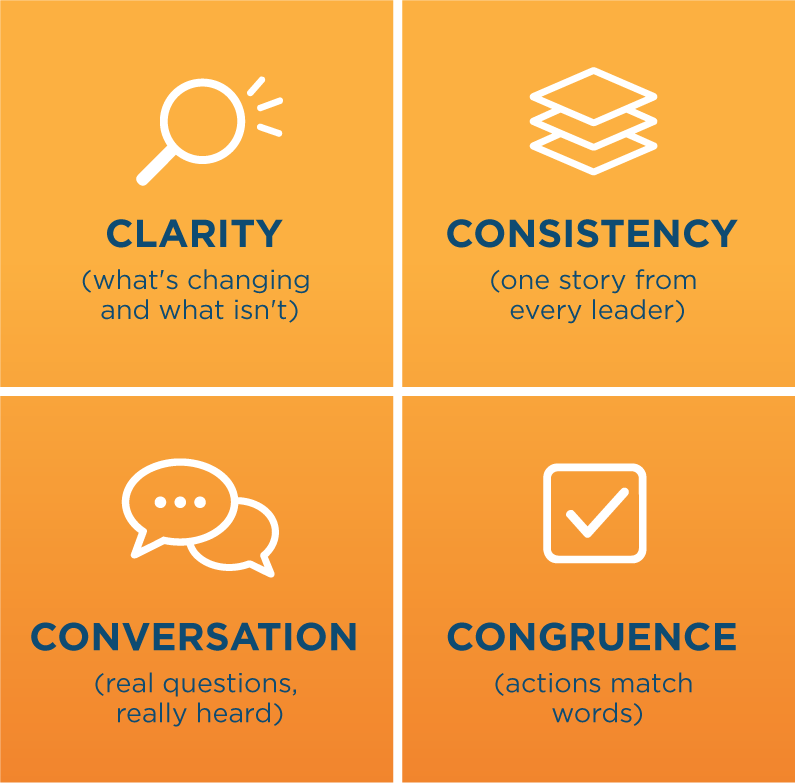
The problem usually isn't how much we communicate. It's what that communication is missing. People navigating change rarely need more messages. They need four things.
They need clarity about what's changing and, just as important, what isn't. They need consistency, so every leader tells the same story instead of slightly different versions of it. They need conversation: real space to ask questions and be heard, not five minutes of Q&A at the end of a presentation. And they need congruence, so what leaders do matches what they say. When words and actions conflict, people believe the actions.
Without these four, more communication just adds noise. When people can't find a clear story, they write their own, and it's usually the worst-case version. During change, trust comes from clarity, not frequency.
Make the Shift: Share What You Know, What You Don't, and When You'll Hear More
The next time you prepare a change update, resist the urge to add more. Instead, replace it with a simple three-part message:
What we know. What we don't know yet. When you'll hear more.
Naming what's still uncertain builds more credibility than pretending to have every answer. Committing to a date for the next update eases anxiety, as long as you keep that promise, even if the update is "we don't have news yet." Then follow it with a listening session instead of a presentation. Keep groups small, listen more than you talk, and close the loop by sharing what you heard and what you're doing about it.
Questions to Try Before Your Next Change Update
Pick one or two of these questions to bring into your next change update or team conversation. Try them for a few weeks and notice what changes.

Before you communicate
What do we know for certain right now?
What isn't changing that people need to hear?
What don't we know yet, and when will we?
To build consistency across leaders
Could every leader explain this change in two sentences?
Where might our messages be drifting apart?
Do our managers understand the why, not just the what?
In your listening session
What are you hearing on your team?
What worries you most about this change?
What would help this feel clearer?
To reflect as a leader
Would our people describe our change communication as clear, or just frequent?
Do my actions this week match what I've been saying?
Where am I adding volume when what people need is clarity?
When you feel the urge to send one more email, pause. Ask whether it adds clarity or just adds noise. Sometimes the most powerful communication is a shorter message followed by a better conversation.
Ready to Communicate With Greater Clarity?
If your change communication feels frequent but not clear, let's start the conversation. EnSpark helps leadership teams align on a consistent message, create space for real dialogue, and lead change in ways that build trust. Contact us to get started.

About the Author
Laura Gramling has the experience and expertise to help you transform your organization in an AI-driven world. Together with her talented team, she builds on the strengths of your people to help them embrace the future with confidence. Laura approaches every client engagement knowing that each person brings a unique and vital perspective — unlocking a greater collective willingness to move forward.
With over 20 years as a change, leadership, and performance consultant, Laura has guided organizations across industries including higher education, tech, and pharma. She is an expert in organizational performance, meeting design and facilitation, and navigating complex change.