
The Four Pillars of Extraordinary Leadership: Pillar One — Innovation
By Laura Gramling – Founder & President

Leading in today's environment requires more than managing change. It requires navigating constant complexity.
Artificial intelligence, shifting workforce expectations, evolving customer demands, regulatory uncertainty, and global disruption are reshaping how organizations operate and compete.
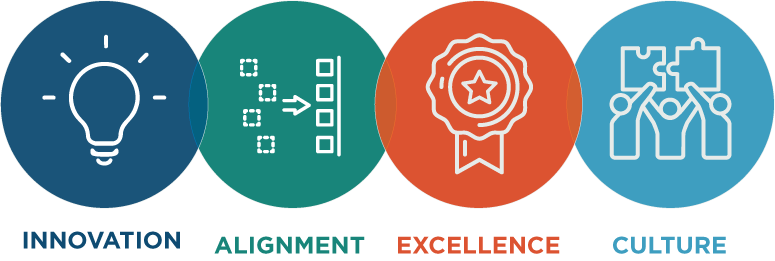
In our work with leaders across industries, we've found that organizations that thrive amid this complexity consistently strengthen four interconnected pillars: Innovation, Alignment, Excellence, and Culture.
Together, these pillars create the foundation for sustained performance, adaptability, and growth. They are not separate initiatives. They are mutually reinforcing capabilities that enable organizations to respond to change, execute strategy, and achieve extraordinary results.
In this four-part series, we'll explore each pillar and the leadership practices that bring it to life.
We begin with the first pillar: Innovation.
Innovation Starts with Safety: Creating the Conditions for Better Ideas
Innovation has become a business imperative.
Organizations across every industry are navigating rapid technological change, shifting customer expectations, workforce transformation, and increasing complexity. Artificial intelligence is generating possibilities faster than many teams can evaluate them. New competitors emerge from unexpected places. Long-standing assumptions become obsolete almost overnight.
In this environment, innovation is no longer a competitive advantage. It is a requirement for staying relevant.
Yet many leaders continue to approach innovation the wrong way.
They ask teams to "think outside the box," "be more creative," or "bring new ideas forward." While well-intentioned, these directives rarely produce meaningful results on their own. Innovation does not emerge from mandates. It emerges from culture.
More specifically, it emerges from environments where people feel safe enough to think differently.
The greatest barrier to innovation is rarely a lack of intelligence, talent, or ideas. More often, it is fear.
Fear of being wrong.
Fear of being judged.
Fear of challenging existing practices.
Fear that speaking up may carry personal or professional risk.
When people experience these fears, they begin to self-censor. They keep questions to themselves. They avoid proposing unconventional solutions. They choose agreement over exploration. As a result, valuable insights remain hidden and opportunities are missed.
This challenge appears in organizations of every size and sector.
In pharmaceutical companies, employees may hesitate to question long-standing processes. In higher education, junior faculty may withhold perspectives in the presence of senior leaders. In technology organizations, relentless pressure to deliver can leave little time for reflection, experimentation, or learning.
The common thread is not capability. It is psychological safety.
Psychological safety exists when individuals believe they can contribute ideas, raise concerns, ask questions, and challenge assumptions without fear of embarrassment, punishment, or exclusion. When this foundation is present, innovation becomes far more likely.
Extraordinary leaders understand this.
Rather than positioning themselves as the source of all answers, they create space for discovery. They ask thoughtful questions. They encourage curiosity. They celebrate learning and experimentation, even when outcomes are imperfect. They intentionally draw out quieter voices and create opportunities for diverse perspectives to be heard.

This approach aligns closely with an All Voices Heard culture.
When people genuinely believe their perspectives matter, the collective intelligence of the organization expands. Teams begin to see challenges from multiple angles. Cross-functional collaboration creates unexpected connections. Problems that once felt unsolvable become opportunities for creative thinking.
Innovation becomes less about individual brilliance and more about unlocking the potential that already exists within the organization.
Putting Innovation into Practice
Creating a culture of innovation does not require a complete organizational overhaul. It starts with small but intentional shifts in how leaders engage their teams. Success can start with examining how you lead your own meetings and conversations. A few practical shifts make a meaningful difference.
Before the meeting:
Send one or two questions in advance so people have time to think before the room creates pressure to conform
Consider who is in the room and who is missing. Diverse perspectives, including those from different levels, functions, and backgrounds, surface ideas that homogeneous groups overlook
During the meeting:
Hold your own opinion until others have spoken. When leaders share their view first, it narrows the conversation before it has a chance to open up
Use small-group discussion before large-group sharing. Quieter voices contribute more freely in smaller settings, and those voices often carry the most original thinking
When someone challenges an assumption, respond with curiosity before evaluation. "Tell me more about what's behind that" goes further than "interesting, but here's why we do it this way"
Recognize people who raise hard questions or propose unconventional ideas. What gets rewarded gets repeated
As an ongoing practice:
Audit your last five meetings. Were the same people talking? Were disagreements welcomed or smoothed over? The pattern will tell you more than any survey
Celebrate experiments, not just wins. When teams know that a well-designed attempt that did not succeed is valued, they stop waiting for guaranteed outcomes before bringing ideas forward
Make it easy to contribute ideas outside of meetings too, through anonymous input tools, open channels, or structured listening sessions
The goal is not to run better brainstorming sessions. It is to build an environment where people bring their real thinking to work every day. Over time, these practices build trust. Trust creates safety. Safety encourages contribution. And contribution fuels innovation.
Organizations that thrive in complexity are not necessarily the ones with the most resources or the most advanced technology. They are the ones that consistently create environments where people are willing to learn, adapt, and think differently together.
Ready to build a culture where innovation thrives?
Want to continue the journey?
Subscribe to All Voices Heard and be the first to receive the next article in this series. In Pillar Two, we'll explore the alignment practices that help organizations turn strategy into action and keep even the strongest plans from losing momentum during execution.
And if you are ready to explore what building a more innovative, All Voices Heard culture could look like in your organization, Contact EnSpark to learn how strengths-based leadership and an All Voices Heard approach can unlock greater creativity, engagement, and performance across your organization. We would love to learn what you are navigating and where we might be able to help.
Next in this series: Pillar Two — Alignment. We'll explore why even the best strategies fail when teams lack shared clarity and collective commitment, and what extraordinary leaders do to create alignment that actually drives results.

About the Author
Laura Gramling has the experience and expertise to help you transform your organization in an AI-driven world. Together with her talented team, she builds on the strengths of your people to help them embrace the future with confidence. Laura approaches every client engagement knowing that each person brings a unique and vital perspective — unlocking a greater collective willingness to move forward.
With over 20 years as a change, leadership, and performance consultant, Laura has guided organizations across industries including higher education, tech, and pharma. She is an expert in organizational performance, meeting design and facilitation, and navigating complex change.